While Ethics as a science addresses the recognition of moral qualities and behaviors, Moral Philosophy—as a branch of Deontological Philosophy—is tasked with the rational and philosophical investigation of the criteria and standards of ethical values. In conjunction with these criteria, it examines the diverse justifications provided by various ethical schools for moral values, a field known as Axiology. Within the framework of religious beliefs, ethics constitutes one of the most fundamental subjects of religious epistemology, governed by specific criteria and standards. These standards are reflected in the discourses of religious leaders through divine revelation. In the teachings of Imam Ali (peace be upon him)—who was a profound practitioner of the Prophet’s (pbuh) ethical school and remains an authentic paradigm of Islamic morality—these values and their underlying criteria are articulated. Accordingly, this study aims, within the scope of this article, to examine the criteria and standards of ethical values from the perspective of three prominent ethical schools and the ethical school of Imam Ali (peace be upon him), with a particular emphasis on Nahj al-Balagha, while elucidating their points of convergence and divergence regarding these values.
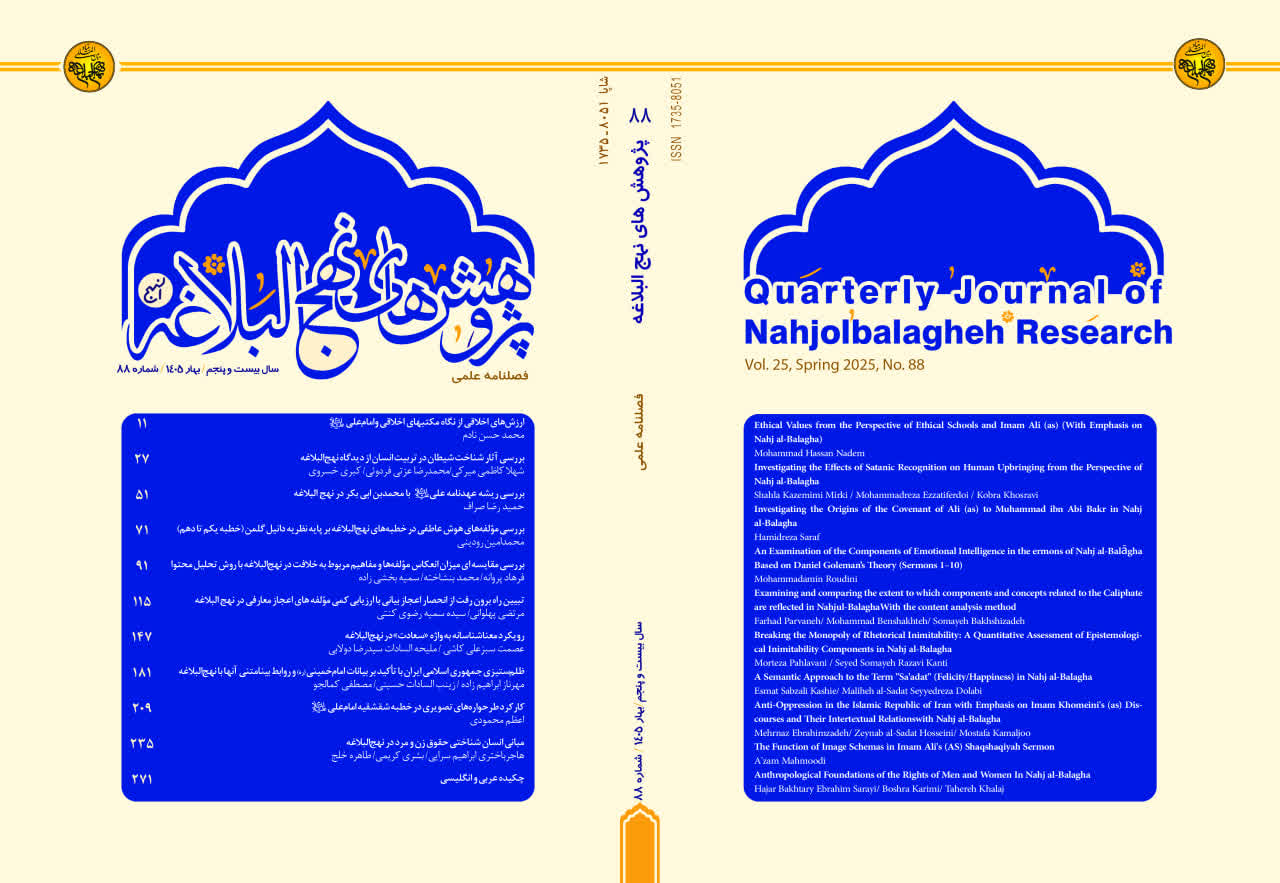
nadem, M. N. (2026). Ethical Values from the Perspective of Ethical Schools and Imam Ali (peace be upon him) (With Emphasis on Nahj al-Balagha). Nahjolbalagheh Research, 25(1), 11-26.
MLA
nadem, M. N. "Ethical Values from the Perspective of Ethical Schools and Imam Ali (peace be upon him) (With Emphasis on Nahj al-Balagha)", Nahjolbalagheh Research, 25, 1, 2026, 11-26.
HARVARD
nadem M. N. (2026). 'Ethical Values from the Perspective of Ethical Schools and Imam Ali (peace be upon him) (With Emphasis on Nahj al-Balagha)', Nahjolbalagheh Research, 25(1), pp. 11-26.
CHICAGO
M. N. nadem, "Ethical Values from the Perspective of Ethical Schools and Imam Ali (peace be upon him) (With Emphasis on Nahj al-Balagha)," Nahjolbalagheh Research, 25 1 (2026): 11-26,
VANCOUVER
nadem M. N. Ethical Values from the Perspective of Ethical Schools and Imam Ali (peace be upon him) (With Emphasis on Nahj al-Balagha). Nahjolbalagheh Research. 2026;25(1):11-26 (In Persian).